


 Tired of learning songs just by listening to it? Want to learn how to read notes? A note tells you the relative duration and pitch of a sound. It is important to learn both for you to be able to play music correctly. Let's start off with the duration or rhythm of a note. I have a perfect app for you. "Rhythm Sight Reading Trainer" is a good app for starters. It trains you to read the value of a note. How long you should play it, when to stop, etc..
The app consists of a metronome and notes to play. You can adjust the difficulty, options, sounds that will help you more on your training. The metronome is spot on and your job is to tap the rhythms you see to
the beat. The app detects how close you were to being on and gives you a
score at the end of the exercise. It is really easy to change the
tempo by just sliding the metal bar up and down on the classical
metronome. You can change the tones of the drum you tap and it even has
the ability to change for those who are left-handed !

Rhythm Sight Reading Trainer
Star Scales Pro 2.1 – Sharpen Guitar Skills Practicing Scale Patterns
JoyApps s.r.o. is pleased to announce the update of their guitar master app Star Scales Pro 2.1 for iPhone, iPod touch and iPad users. Star Scales Pro 2.1 is an all in one app tool teaching scale patterns instead of complicated charts. The update incorporates newly graphics, nice fretboard interface and improved guitar sound.
Star Scales Pro 2.1 app gives names to each scale’s fingering and note at every position on the fretboard so that it can be used by right or left handed players in easy to master pattern. Star Scales Pro 2.1 supports scale patterns for 6 or 7 strings guitars so that everyone is enabled to make the process of learning fast and enjoyable.
Beginners and pros can improve speed accuracy as well as building muscle memory and confidence playing the guitar choosing one of various scales patterns from jazz to rock. The users are enabled to switch between different keys, tunings, playback mode as well as create favorite scale patterns, find necessary one for with search bar tool.
Feature Highlights:
* Clustered scales for easy orientation
* Double length playback for root note of the scale
* Scale pattern on the whole fretboard in landscape mode
* Random generator to getting to practicing to the scales
“We would like to make the play on the guitar as easy as it could be. Time and time again, the pattern method has been proven the most effective method for learning scales that is why we hope scale pattern will assist in achieving better results”- said Zoltan Bognar, the developer of the Star Scales Pro 2.1 app.
Supported Languages:
* US English, German and Slovak
Device requirements:
* iPhone and iPod touch and iPad
* Requires iOS 3.0 or later
* 11.5 MB
Pricing and availability:
Star Scales Pro 2.1 is $0.99 and available worldwide through the App Store in the Music category.
Slash, Now Producing Horror Films

Jonathan W.C. Mills wrote the screenplay which should begin shooting early next year, but a director hasn't been revealed just yet. Here's what Slash had to say about his new endeavor, "I've always been a huge horror fan and creating films that take you back to the days where horror movies actually scared the hell out of you is something I've always wanted to do. My audience is made up of young, edgy, discerning consumers, with an appetite for quality and a hint of anarchy." That's what way to put it, I guess. Though I'm not a fan of the horror genre, I've found some decent throwback horror flicks like House of the Devil to be quite good. It'll be interesting to see if Slash can bring together the right talent for some fresh horror.
Joe Satriani Got A Music Career
A funny thing happened to Joe Satriani on the way to a music career. He got a music career.Apparently, the guitar virtuoso with the shaved head, massive following, and 15 Grammy nominations didn't expect success to follow him. Not from the day he took up the instrument at 14 as a tribute to Jimi Hendrix until today.
"I'm always surprised," Satriani said Thursday. "I wasn't expecting or aiming for or prepared for a career."
 Having taught some of rock's biggest names -- Kirk Hammett of Metallica, Steve Vai, David Bryson of Counting Crows, and Kevin Cadogan of Third Eye Blind for starters -- it was Satriani's "Surfing with the Alien" release in 1987 that launched his popularity. The record was the first all-instrumental to reach No. 29 on the Billboard Charts, anchored there for six weeks. It remained in the Top 200 for more than a year.
"To be in the Top 40 was pretty amazing," Satriani said.
With the album's success, Satriani was nudged into his first national tour. He was a baby learning to walk.
"I didn't know what to do," said the 54-year-old musician.
It all started ominously. The first show into a three-week tour, the band's plane caught fire and made an emergency landing.
At that time, Satriani had no roadies so he hoisted his own equipment on stage.
"The audience was looking at me like, 'You have no roadies?' and I'm thinking, 'What do I do next?'" said Satriani. "What does an instrumental artist do on stage?"
It wasn't long after when Satriani got the call from Mick Jagger, starting his own solo tour and needing a lead guitarist. The experience made an indelible mark."I was back playing guitar for a real singer," said Satriani, who has little confidence in his own singing.
"Working with Mick was an incredible experience," he said. "He's an incredible performer. We hung out in New York City for a month just rehearsing and a month in Japan. I was just so knocked out by his dedication and musicianship. When I got back to my own tour, I was inspired and ready to put myself forward. I don't know how to explain it."
The Jagger tour was also a cram course in media attention for "Satch."
"I was on the cover of a lot of magazines with people asking me how to pronounce my last time, where I came from, and so on," he said.
It was 1979 when Satriani met drummer and now Benicia resident, Jeff Campitelli. Both remain friends and bandmates.
"He's a very humorous person," Satriani said. "And he's an incredible dancer. When he plays drums, he's just as crazy. Very unpredictable. Holding him down to a pattern has been a lot of work. That's his charm, how he makes the groove and sound so interesting."
The Uptown gig is a tune-up for a national tour to promote "Black Swans and Wormhole Wizards," with a copy of the new CD handed to all paid customers in Napa.
"The first show (of a tour) is always kind of crazy," Satriani said. "You find out if your gear is truly appropriate for the job. There's a lot of sorting out that goes on. People that show up are usually the hard-core fans who know we're scrambling to pull it all together. It makes for a great evening."
Unveiling songs from a new CD live is always a thrill, Satriani said.
"It's a very long process. Some of the songs have been with me for years," he said. "And I finally get to play them in front of people. It's one of the main things I live for. And by the end of the tour, you've felt like you've accomplished what you set out to do. It's very cathartic for me. When the tour is done and this is out of my system, I get to walk upright as a normal man."
There remains a handful of tunes Satriani knows he has to play for the devoted fans since 1988.
"They just have to see you play that song, though you've done it every tour," he said. "You try and mix in as much new material with material from the catalogue."
Sometimes, Satriani gets a taste of Hollywood, be it in a Christopher Guest movie, "For Your Consideration," or re-enacting his solo National Anthem in a 1992 Oakland A's game for the Brad Pitt/Philip Seymour Hoffman upcoming film, "Moneyball."
"Movie sets are fun for me," said Satriani, who retrieved the same gear, jacket and hat he wore in that 1992 Oakland Coliseum appearance to make the baseball movie authentic.
Though Satriani "didn't exactly sit around and have lunch" with the stars, he recognized their talents.
"Brad Pitt has that star quality about him," Satriani said. "He's tall, good-looking and an imposing figure with an amazing voice."
That's where Pitt and Satriani can bond: Neither is known for carrying a tune.
"There are quite a few recordings where I'm singing," Satriani said. "But real singers have this power and width in their voices. It's really unbelievable when you're standing next to that. I can vocalize, but I can't really sing. They are two completely different talents. I can hit the notes, remember the lyrics. But I'm a guitar player who can vocalize. I think my audience knows that."
Setting the Guitar Pickup Height
Setting the height of your pickups at first thought seems like an elementary adjustment with few pitfalls. However, as you will see below, it can be quite a complex adjustment to get right and exactly to your tastes. There are also a few ways you can go wrong - particularly with certain types of pickup.
Effects of Pickup Height
Volume
This is the most obvious effect from changing the height of your pickups. Closer to the strings and the pickups will be louder, further away and the volume decreases.
Signal-to-Noise Ratio
Signal-to-noise ratio (often abbreviated as S/N) is the ratio between the level of the signal and the level of unwanted noise. The noise of any device is usually fixed, but if the signal level can be strengthened, the S/N improves. O.K. Got that out of the way. What this means to you as a guitarist is that if you can raise the volume of the guitar (the signal), the sounds you don't want (the noise), such as the hum from single-coil pickups or the hiss from an effects pedal is quieter in comparison. Even simpler? Noise bad, guitar sound good... got it?
So when the pickups are closer to the strings and putting out more volume, while the hum and hiss from your system stays at the same level, the S/N improves. Yay!
Tone
While while the exact effect depends on the specifics of the pickups themselves (how powerful the pickups are and how microphonic the coils are), closer to the strings, you will usually get more punch and percussive attack, as well as an increase in brightness. Backing off the pickups mellows out the attack, darkens the tone and you will start hearing more of the body's tonal contribution.
Sustain
Closer to the strings will also affect sustain more, reducing it. This is due to the magnets of the pickups pulling on the strings themselves. You may not notice this at all with loud, driven sounds and a guitar with lots of sustain to start with. Pickups with low gauss (lower powered magnets) such as Kinman, EMG, Lace Sensors and most rail type pickups do not suffer from this as much, and as such, can usually be set very close to strings.
Intonation (Stratitis)
This leads on from the sustain issue above. When the magnets are too close particularly with the neck and middle pickups, the pull on the string gets strong enough to pull it out of tune, or introduce false harmonic node points.
You'll know when you have this as you get a permanent "out-of-tune" sound and often you'll hear false "harmony" notes mixed in with the original notes, causing beat frequencies (the "pulsing sound you hear when two notes are slightly out of tune with each other). This also gets worse as you play higher up the neck (which brings the strings down closer to the pickups), and will be more pronounced on the lower, thicker strings.
This is particularly a problem with conventional single-coil pickups, which usually have fairly strong magnets - which is why it's known as Stratitis. However, even humbuckers with powerful magnets can have this problem. Once again, low gauss pickups do not suffer from this problem anywhere near as much.
Fret Buzz
The pull from the magnets has yet another side effect - string crashing, which causes fret buzz on guitars with lower action. The pull of the magnets changes the vibration pattern of the strings, pulling them down closer to the frets. Aside from the audible fret buzz, this can also affect sustain. Once again, this is not a problem with pickups that have low gauss magnets.
Compression
I believe (not everyone agrees with me though) that when a pickup is driven harder by moving it closer to the strings, it actually compresses the pickup's output a little, making your quieter sounds stand out more, and cutting down a little on the level of louder playing. This effectively compresses the signal into a smaller dynamic range. While a little compression can be a good thing, some players have reported that this makes string noise stand out too much for them with high gain settings.
Comfort
When the pickups are set really high, they can interfere with playing, getting in the way of plectrums and especially fingernails (for those of us who play with nails).
String to String Balance
With vintage style single-coil pickups that have staggered polepieces, the volume levels between strings can differ substantially. This is particularly a problem with the G string which is an unwound string in modern sets - while the vintage magnet stagger caters for a wound string. Lowering pickups a little helps minimise this problem, evening out the string-to-string balance.
Setting the Height
It's all a Question of Balance
The secret to setting the heights properly is first setting the pickups to work together well, with balanced volumes on all switch settings and also from bass to treble side on the same pickup. Once this is done, the heights can be adjusted up or down together to find the tone you are looking for. For this second part, it's useful to have a rough idea of what you want from your instrument. There are two extremes:
| Distance from strings | Tone | Application |
| Close | Loud, punchy, slightly compressed, percussive, focused, brighter | Lead playing or heavy drive/distortion sounds with as little noise as possible |
| Further | Smoother, warmer, more character, more dynamic range, "woodier" tone, better balance | Cleaner sounds with more complexity and more dynamic music styles |
While you may play a style of music that leans towards one or the other extreme exclusively (Death Metal vs. Jazz), most players are going to need to be a bit more flexible and settle for a balance between the two.
Note: As with virtually any guitar adjustments, always make sure the guitar is tuned to pitch before you start. There are good reasons for this - trust me.
From the Neck Down
First make sure that the neck pickup is not causing any major problems, such as Stratitis, fret buzz or affecting the sustain too badly. You start with the neck pickup as it is more prone to causing these problems than the other positions. The easiest way to approach this is adjust it up until it starts causing problems, then back it off slightly until they clear up again. Keep the treble and bass sides level with each other for now.
'Nother Note: To check for these problems, play the last frets on the fingerboard (closest to the body) and specifically the lower thicker strings - which have more mass to be affected by the magnets. The low E string played at the 21st/22nd fret is always a good indicator of trouble.
Pickup to Pickup Balance
Now it's time to set the heights so that the volume between pickups is balanced to taste. In most situations, you don't want your volume to change too much when you switch from one pickup to another. One exception to this is if you want a volume and drive boost from the bridge pickup when used alone for solos - then you will set this one pickup to be louder than the others. Even then, it's useful to start with all the pickups at a similar output level, and then raise the bridge pickup to taste after the initial setting.
Note: If all the pickups have the same power output, and are set to the same distance from the strings, the neck pickup will always be the loudest pickup, followed by the middle, with the bridge pickup being the quietest. This is not due to the pickups themselves, but rather that the strings are less constrained the further from the bridge they are, able to vibrate freely. This is also why the tone changes, becoming bassier further from the bridge and why the neck pickup is more prone to Stratitis. Many modern sets of pickups have a more powerful bridge pickup to help balance bridge to neck levels.
- Play full chords using all six strings and sustain them while you change from one single pickup to another and listen for any volume jumps or drops.
- Avoid all the two pickup sounds for now (such as switch position 2 & 4 on a Strat and the middle position on a Les Paul).
- Adjust pickup heights by turning screws one full turn at a time on both screws belonging to a pickup. Remember your neck and middle pickup heights should already be as close to the strings as possible, so lower whichever one of the two is loudest.
- Finally raise or lower the bridge pickup to balance levels with the other two.
To set the bass to treble balance, use the following method:
- Set the selector to a single pickup, and alternate between playing the bass three strings and the treble three. I use a reggae type bass-treble "skank", but single notes could work just as well.
- If the bass side is too loud (most likely), lower the bass side screw a half turn and raise the treble side screw a half too.
- If the treble is louder, lower the treble side only.
- Once you have done this with all the pickups, do a quick final check of pickup to pickup balance again.
Now that you have everything all set up nicely with an optimum balance and maximum height possible, it's time to set the height so that the tone and output level are what you want.
To do this, lower all the pickups together, turning every screw by the same amount until you get the tone and output level that you like.
As mentioned in the first part of this article, backing off the pickups will sound smoother and warmer with a "woodier" tone. The tone will have more character, complexity and dynamic range, as well as having better string to string volume balance.
It is also possible to experiment with your pickup to pickup and treble to bass balance at this point, depending entirely on what you want from your guitar. Remember, this is an entirely personal setting, and there are few "wrong" setups.
Manufacturer's Recommendations
The manufacturer's recommendations are just that - recommendations. It is usually a middle ground starting point from which you can feel free to deviate. In fact, Fender's recommendations do not even take into account the pickup position. I have included them here for completeness and a rough starting guide.
| Fender Single-coil Pickup Recommendations | ||
| Bass Side | Treble Side | |
| Texas Specials | 8/64" | 6/64" |
| Vintage style | 6/64" | 5/64" |
| Noiseless Series | 8/64" | 6/64" |
| Standard Single-Coil | 5/64" | 4/64" |
| Humbuckers | 4/64" | 4/64" |
| Lace Sensors | As close as desired (allowing for string vibration) | |
| Gibson Humbucker Height Recommendations | ||
| Bass Side | Treble Side | |
| Neck Pickup | 3/32" | 1/16" |
| Bridge Pickup | 3/32" | 1/16" |
Greg Howe's style
Thanks to Mr. Martin Goulding. For this lesson. A little take on Greg Howe's style.
Here is a Greg Howe style example in D Dorian (R 2 b3 4 5 6 b7) The solo starts with a introduction melody using the tremolo bar, before left and right hand tapping through a scalar line that features some string skipping. Again the muting will be crucial to get the line clean and an even velocity between the two hands is essential for the line to sound smooth.
In bar 3, there is a 4th finger roll. Just try to pull the fretting hand back from the wrist very slightly so that the finger actually mutes the B string as it rolls onto the high E string. The phrase ends with a jazzy line using an A augmented triad in beat 4. This can be seen in the context of D Melodic Minor (R 2 b3 4 5 6 7) which is frequently used in conjunction with the Dorian mode. On the slow backing track, I have played the example half speed as written, but when these lines are initially learnt, you may find it helpful to play them as strict 16th notes, which you will hear me demonstrate on the repeat.
The full speed transcribed version is really felt as a constant line which is played as fast as possible while targeting the exit note by feel. The intent wasn’t necessarily to play odd subdivisions!

Check out the Tablatures/Lessons section for more..
Joe Satriani in a Special In-Store Appearance
 Joe Satriani is going to be making two special in-store appearances to sign copies of his new release, Black Swans And Wormhole Wizards, and Guitar World's December issue, which features Satch and the 30 Greatest Shred Albums of All Time.
Joe Satriani In-Store Appearances:
BBY
October 7th in LA
11301 W Pico Blvd
5:30 PM
Borders
October 10th in San Francisco
Store #57 – 400 Post St
5:30 PM
Black Swans and Wormhole Wizards, Satriani’s 14th studio album, was produced and recorded by Mike Fraser (AC/DC, Metallica) and Satriani, and is set for release on October 5, 2010 through Epic Records. Veteran Satriani bandmate Jeff Campitelli joins Joe on drums, while newcomers Mike Keneally (Frank Zappa, Steve Vai) and Allen Whitman (Mermen) are adding their expertise on keyboards and bass (respectively) to the mix. The album's first single, "Light Years Away," can now be streamed at the official Joe Satriani website.
Satriani’s World Tour promoting Black Swans will begin this fall, kicking off on October 16 in Dublin, Ireland with the North American dates starting on December 1 in Atlanta, and will be hitting cities such as Chicago, New York, Boston and more (a second January ‘11 leg TBA).
Joe Satriani North American tour dates:
December 1 Center Stage Atlanta, GA
December 2 Pompano Beach Amphitheatre Pompano Beach, FL
December 3 House of Blues Lake Buena Vista, FL
December 4 Ruth Eckerd Hall Clearwater, FL
December 6 The Palace Theatre Greensburg, PA
December 7 Aronoff Center for the Arts Cincinnati, OH
December 8 Massey Hall Toronto, Ontario
December 9 House of Blues Boston, MA
December 10 Tower Theatre Upper Darby, PA
December 12 Metropolis Montreal, Quebec
December 13 Nokia Theatre New York, NY
December 14 Nokia Theatre New York, NY
December 15 The Music Center @ Strathmore North Bethesda, MD
December 16 Fillmore Detroit Detroit, MI
December 17 House of Blues Cleveland, OH
December 19 Chicago Theatre Chicago, IL
December 20 Uptown Theater Kansas City, MO
December 21 Historic Paramount Theatre Denver, CO
Roger Waters Reclaimed His Legacy

"Normally, we don't know until we get in your car," Waters replies in his crisply British tones, buckling his seat belt. As usual, it's hard to read his chilly blue-gray eyes — color-coordinated these days with his longish, silvery hair and professorial beard — but it seems he's decided to be amused. It helps that Waters just shared an excellent bottle of Montrachet, in celebration of the end of a long workday: After driving into Manhattan this morning from his house in the Hamptons, he endured a biceps, triceps and abdominal core workout ("It nearly kills me, but I need to get a little stronger"), sang scales with the vocal coach who's been helping him reclaim the high notes of his youth, met with a stylist to select stage clothes in various shades of black (rejecting one pair of leather boots as "very Bruce" and another as "too Pete Townshend") and spent hours in a downtown production studio, making minute tweaks to lighting and digital animation.
He's been working at this pace since January, determined to perfect the first real touring version of what he considers the defining work of his career, the 30-million-copy-selling The Wall — the 1979 tale of an alienated rock star named Pink whose biography bears a distinct resemblance to his own. Pink Floyd's original live version — with its giant puppets, synchronized graphics and that wall, constructed brick by brick, then knocked down at the show's climax — set a standard for every rock spectacle that followed, from Steel Wheels to Zoo TV. But it hit a mere four cities worldwide, with months passing between each block of shows. No footage was officially released from the performances, so they've become a dimly recalled legend — except for Gerald Scarfe's surreal animation, which also appeared in 1982's film version.
 The shows lost money at every date — tickets were around $12 — and the band was falling apart. "They were getting to the point where they couldn't stand the sight of each other," says Mark Fisher, the architect who built both the 1980 and 2010 versions of the tour (and also worked on the "spaceship" stage for U2's 360û Tour). "It was all too convenient that they got to declare that the whole thing was a turkey and way too expensive and walk away from it on those grounds."
Lighting director Marc Brickman, who also worked on the new show, was brought in just before the beginning of the original performances. "It was just mind-blowing — I was speechless," says Brickman. "It was mounting opera at a rock & roll show. In 1980, you couldn't even dream of that show." For Waters, the idea behind arena theatrics was simple: "You can't ask people to go to the circus and just have fleas in the middle — you've got to have elephants and tigers."
3D Guitar Pickups
Natural Stereo & Natural Mono - A new 12 coil pickup technology
Regular mono pickup coil positions only reads the Y axis of the string movement.3Dxy technology uses 12 coils to read 6 strings, and read both axis (X and Y), that means vertical and horizontal string movement.
In 3Dxy system each string has two coils. Both coils make a 90º angle, and read the string position in the space. Each coil reads a different signal but complementary. When we hear both signals in a stereo sound system it produces a natural surround sensation 3D.
This is what we call "natural stereo".

The resulting natural mono signal has all the details of the 3Dxy natural stereo, but we loose the surround 3D feature.
We can say that natural mono is more rich than traditional mono, because now we have complete string vibration information (X and Y axis).
The 3Dxy pickups output level and sensibility is grater than old mono pickups. This is because 3Dxy pickups have more spins in a grater number of coils (two in one string).
3Dxy pickups offer beter harmonics and larger decay. This was one of the sweet things that we discovered. There is no difference with an acoustic harmonic. And that is possible because we read both axis (X and Y) in two separated coils. Another reason to call it natural stereo and natural mono, even natural harmonics.
Here's a close up view of the pickups in action:

Gibson Issuing Three New John Lennon Signature Acoustics
Seventy years after his birth and three decades after his untimely passing, John Lennon's message of peace continues to touch the masses, and his songs still resonate in the hearts and minds of fans around the world. At the request of Yoko Ono, Gibson Guitar is proud to offer three 70th Anniversary John Lennon J-160E acoustic guitars to celebrate the legacy of this extraordinary artist. Accordingly, only a very limited number of these handmade acoustics will ever be available.
 In 1962, John Lennon was still an up-and-coming artist, and though one of two main singer/songwriters at the heart of The Beatles, was scraping by on the little money the band was bringing in at that time. For his first quality American acoustic/electric guitar, Lennon had his sights set on a new Gibson J-160E—the problem was, he didn't have the money to buy it. With the aid of a co-signed purchase from Beatles manager Brian Epstein (who also co-signed for bandmate George Harrison's J-160E), Lennon made the guitar his own, and put it straight to the business of making rock and roll history. Recreated by the luthiers at Gibson's Montana acoustic guitar facility in period-perfect detail, the 70th Anniversary John Lennon models are available in three distinct versions to represent the instrument at three periods in Lennon's life and career. The first, finished in Vintage Sunburst and limited to 500 guitars, represents the guitar as it was when Lennon first acquired it and used it on several famous Beatles recordings from 1963 to '64, including Please Please Me, With The Beatles and A Hard Day's Night.
The custom shop's second and third renditions are limited to 70 guitars each, one for every year since John's birth in 1940, and both include a special 70th Anniversary Certificate personally signed by Yoko Ono and sent to the final purchaser by Certified Mail. As for construction, each version is an accurate rendition of the J-160E of 1962, a guitar originally released in 1954 as one of the world's first successful "electro-acoustic" guitars, with built-in pickup and electronics and ready to hit the stage for the professional performing musician. Beloved by Lennon, and kept close throughout his too-short life, the 70th Anniversary John Lennon J-160E is a guitar every Beatles fan will want to make their own.
Carlos Santana Performs the Greatest Guitar Classics of All Time
 Yes, the title said it all. Guitar Heaven: The Greatest Guitar Classics of All Time.
It's an album that will be released today September 21, 2010. It is a cover album and a lofty collaboration pairing Santana with some of today's most popular vocalists and featuring a wealth of classic songs specifically renowned for the quality of their respective guitar parts. The result? Highlights include Chris Cornell singing Led Zeppelin's "Whole Lotta Love," Train's Pat Monahan singing Van Halen's "Dance The Night Away," india.arie & Yo Yo Ma with the Beatles' "While My Guitar Gently Weeps," Linkin Park's Chester Bennington joining forces with the Doors' Ray Manzarek on their "Riders On The Storm," Rob Thomas singing Cream's "Sunshine Of Your Love," Scott Weiland with the Rolling Stones' "Can't You Hear Me Knockin'," Chris Daughtrey on Def Leppard's "Photograph," Gavin Rossdale with T. Rex's "Bang A Gong," rapper Nas with AC/DC's "Back In Black," Joe Cocker singing Jimi Hendrix's "Little Wing," and more.
Pup Aid 2010 supported by guitarists
Guitarists and other celebrities took time to support Pup Aid 2010. A classic Epiphone Casino guitar was auctioned signed by rock legends Liam Gallagher, Paul Weller, Gary Moore and The Clash’s Mick Jones. The money from the auction will go to Dogs Trust Shoreham, the Kennel Club Charitable Trust, which invests money in dog health research and dog welfare charities and Oldies Club – a small charity re-homing older unwanted dogs.
PUP AID 2010 is about choosing a happy and healthy dog by adopting from a rescue shelter or responsible breeder, and is the brainchild of Brighton-based TV Vet Marc Abraham, resident vet on ITV’s This Morning, Sky1’s My Pet Shame and More4’s dfs Crufts.
“Puppy farming has been going on in this country for years with no-one able to stop it,” Marc says. “By raising awareness as much as possible with live music and dog-loving celebrities, we can all help to stop the growing demand for these poorly pups and finally end the pain once and for all. We hope that as a result of this event people will remember to go to a rescue home or to buy a puppy from a Kennel Club Accredited Breeder, rather than unwittingly fuelling the cruel puppy farming trade. This will prevent the suffering of millions of dogs now and in the future.”
Dj Ashba now a member of Guns N' Roses
 Guns N' Roses is proud to announce that guitarist n' songwriter Dj Ashba has joined the band. Ashba, who officially replaces current NIN guitarist Robin Finck, is best known as co-founder of hard rock bands Sixx AM and Beautiful Creatures.
"Dj's a gifted, energetic guitarist that Guns N' Roses is proud to have on board!!" exclaims Axl Rose. "We're very excited to have the opportunity to work together. Guns' radar has silently been aware of Dj's presence for quite some time. He brings a fresh approach to our particular brand of mayhem expanding the tapestry of Guns N' Roses live. Once Dj's name was in the hat, the hat disappeared!!"
"It's an honor to have the opportunity to be a part of a band that I have always loved and respected," said Dj Ashba. "I'm looking forward to working with Axl, who is not only one of the few great front men of our generation, but a true artist."
Dj Ashba co-wrote and co-produced Motley Crue's latest album Saints of Los Angeles, which garnered a 2008 GRAMMY nomination for Best Hard Rock Performance, as well as co-wrote and co-produced the Sixx AM album Heroin Diaries.
Robin continues to be part of GN'R, by virtue of Guns' history and his involvement in Chinese Democracy.
Now, one step closer to the abyss, Ashba joins a band who's all time roster is nearly as long as it's founder Axl Rose's rap sheet!
Kirk Hammett can't seem to get what James is teaching
Here's a funny video of Kirk. Imagine the guitarist of Metallica can't do a simple riff.






Altered Scales And Chords
Greg Howe on altered scales and chords (Premier Guitar Magazine)
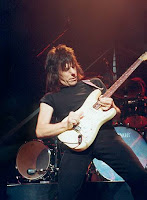
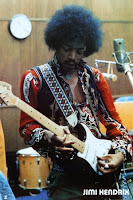
One of the subjects I get asked about much more frequently these days is the subject of altered scales and chords. It is a fairly large and sometimes confusing subject, due to the ambiguous nature of certain definitions describing many associated musical terms and concepts. For our purposes, we will categorize an altered chord as simply a dominant chord in which either the fifth or ninth has been raised or lowered by a half step. The most popular altered chord played on guitar is probably the #9 chord, commonly referred to as “the Hendrix Chord,” shown in Fig. 1.

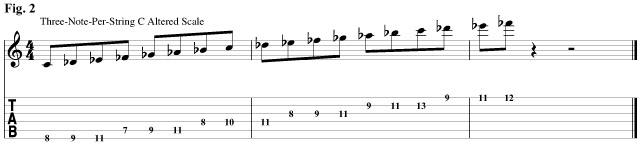
Fig. 2 shows a three-note-per-string C altered scale. The easiest way to play the altered scale is to move up a half step from the established root and play the Melodic minor scale.
More Examples
Fig. 3 enables us to play the notes of C altered simply by playing Db Melodic minor. It can also be helpful if you preface the scale by playing an altered chord. Fig. 4 is a C7#5 chord, which is altered and sounds very compatible with the C altered or Db Melodic minor scale.


In this scenario, we will also focus on two arpeggios that can be very effective in emphasizing the tonal characteristic underlying the altered sound. The shapes in Fig. 5 and Fig. 6 are very similar to shapes we’ve seen before, in that they are based off a 5th string root with the exact same format as those in previous articles.

The simplistic version of what’s happening here is that we are playing Db Melodic minor over a C altered chord. Though this is not the only method that can be used in addressing altered chords, it is certainly one of the more popular methods and definitely my favorite. I will discuss typical chord progressions that enable us to use altered chords and scales in my next article.
My next article will also focus on modifying this month’s shapes, so becoming familiar with them will help you see the logic in the design of the upcoming licks. In the meantime, have fun with these shapes and work on getting your ears accustomed to these tonal qualities. See ya next time.

Josh Farro


Guitars
* Custom Fender Telecaster Thinline
* Fender Telecaster Deluxe
* Fender Jazzmaster
* Fender Stratocaster
* Gibson Les Paul Classic
* Burns London Double Six 12-string guitar (Studio - bridge of "Brick by Boring Brick")
* Taylor Acoustic
* Marshall JCM2000 Dual Super Lead head (Along with a Marshall 1960A Angled 4x12 Cab)
* Mesa Boogie Dual Rectifier
* Marshall JTM 45 (Studio - bridge of "Brick by Boring Brick")
Effects
* BOSS Chromatic Tuner
* BOSS DD-20 Giga Delay (x2)
* Digitech Whammy
* Ernie Ball Volume Pedal Jr.
* Keeley Katana Boost pedal (used on "Turn It Off")
* Voo Doo Labs power supply
Misc
* Mogami and George L Cables
* D'Addario EXL110 Regular Light 10-46 Gauge guitar strings (listed on D'Addario as being a user, beginning in 2009), previously a user of Ernie Ball strings.
* Sennheiser ew372 G2 wireless

![[Valid Atom 1.0]](http://www.blogger.com/valid-atom.png "Validate my Atom 1.0 feed")


